
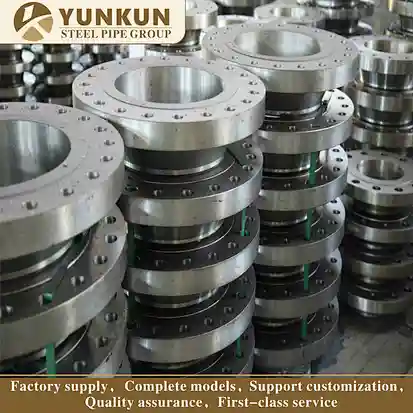
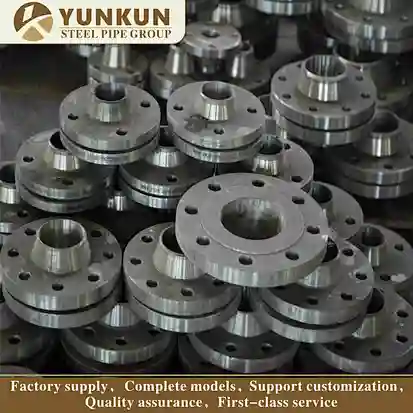
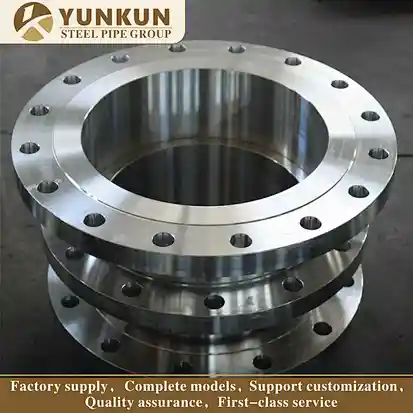
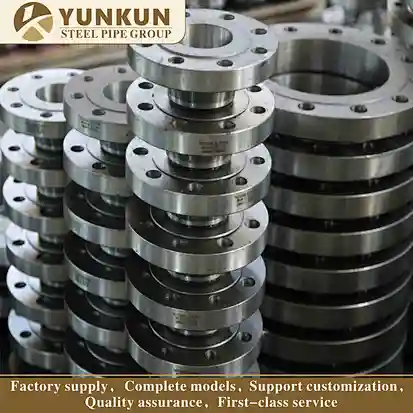
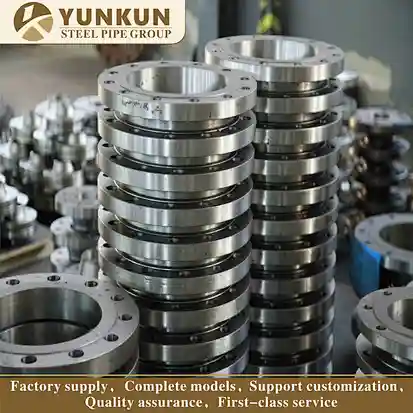
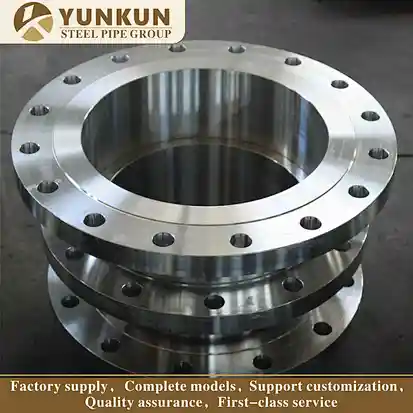
Flanges of various styles and materials
An industrial flange is a disc-shaped metal connector that achieves a sealed connection between pipelines, valves, and equipment through bolt fastening. Its core functions include:
Sealing connection: The precision-machined sealing surfaces (e.g., protrusions, concave-convex surfaces) engage with the gasket to create uniform pressure, preventing medium leakage.
Robust structure: The bolted fastening design withstands internal pressure, external loads, and thermal stresses, ensuring long-term operational stability.
Medium adaptability: Compatible with various materials (e.g., carbon steel, stainless steel, titanium alloy) for water, gases, oils, and corrosive chemical fluids.
II. Classification and Key Parameters
Category dimension | Main types | typical parameter | applicable scene |
pressure rating | Class150-2500 | PN2.5-PN160 | High-voltage systems must meet Class600 or higher standards. |
attended mode | Flat welding (SO), butt welding (WN), and socket welding (SW) | welding workload variance | High voltage selective welding, frequent disassembly with threads |
material quality | carbon steel, stainless steel (304/316L), titanium alloy | Heat-resistant-196°C to 1000°C | 316L for corrosive environments, titanium alloy for high-temperature applications |
III. Typical Application Scenarios
Petrochemical industry: High-pressure pipeline connections require Class900 flanges with metal-wrapped gaskets, with corrosion-resistant materials being preferred.
Power system: Cooling water pipes shall be equipped with 304 stainless steel flanges, with a pressure rating of ≥16 kg, and RF-type sealing surfaces are required.
Shipbuilding: Copper flanges resistant to seawater corrosion, with DN50-DN1000 specifications compatible with various pipeline systems.
Food and pharmaceuticals: 316L flange meets hygiene standards with electrolytic polishing treatment on the sealing surface.
IV. Key Considerations in Model Selection
Pressure matching: The system operating pressure must not exceed 80% of the flange rated pressure.
V. Materials
Carbon steel: ASTM A105,20#, Q235,16Mn, ASTM A350 LF1, LF2 CL1/CL2, LF3 CL1/CL2, ASTM A694 F42, F46, F48, F50, F52, F56, F60, F65, F70
Stainless steel: ASTM A182 F304,304L, F316,316L,1Cr18Ni9Ti, 0Cr18Ni9Ti, 321,18-8;
Alloy steel: ASTM A182 F1, F5a, F9, F11, F12, F22, F91, A182F12, A182F11,16MnR, Cr5Mo
Imported materials: [1] (nickel steel), WC5 (1.25% chromium 0.5% molybdenum steel), WC9 (2.25% chromium), C5 (5% chromium molybdenum), C12 (9% chromium 1% molybdenum), CA6NM4 (12% chromium steel), CA15 (4) (12% chromium), CF8M (316 stainless steel), CF8C (347 stainless steel), CF8 (304 stainless steel), CF3 (304L stainless steel), CF3M (316L stainless steel), CN7M (alloy steel), M35-1 (Monel), N7M (Hastelloy B), CW6M (Hastelloy C), CY40 (Inco nickel alloy)
Comprehensive score